


Market insights
Life after iDEAL? How direct bank payments in the Netherlands are changing

At Money20/20 Europe, one subject kept surfacing. iDEAL – the Netherlands’ successful bank-to-bank payment method – is changing, and merchants aren’t happy about it. Their questions were pointed. What happens to my checkout? Why am I being moved onto something I didn’t choose? And is this actually better for my business, or rather for the banks behind it?
These questions, of course, stem from iDEAL being phased into Wero, a new European payment system, across 2026 and 2027. The change is real, it’s already underway, and every merchant offering iDEAL will eventually need to migrate. Fortunately, there is more choice than this timeline implies.
What’s actually happening to iDEAL
In October 2025, the European Payments Initiative (EPI) – a group of 16 European banks and payment providers – confirmed that iDEAL will be absorbed into Wero, its pan-European digital wallet. ABN AMRO, ING and Rabobank, the banks behind iDEAL, are firmly behind the move, and De Nederlandsche Bank – the country’s central bank – is overseeing it.
The handover happens in phases:
- 2026: The familiar iDEAL logo begins to be replaced by a co-branded iDEAL | Wero logo at checkouts, in banking apps and on payment pages. Merchants are expected to update their branding to the new standard.
- Late 2026 onwards: The merchant rollout begins in earnest. iDEAL contracts become Wero contracts, and the technical migration to the Wero platform proceeds as a controlled, step-by-step process.
- End of 2027: The transition completes. iDEAL is decommissioned, and Wero becomes the only name your shoppers see.
It’s worth being clear about the scale of this. iDEAL accounts for roughly 72% of all Dutch e-commerce transactions and is offered by more than 350,000 businesses. This goes way beyond a logo refresh; it’s a multi-year migration of the most important payment method in the country, and for merchants that want to keep accepting it, it isn’t optional.
What the Wero switch means for merchants
This is where the frustration we heard at Money20/20 comes from, and it’s entirely fair.
Merchants didn’t ask for this change. They’re being moved onto a new system, to a timeline set by a banking consortium, with a migration they didn’t steer and an end state that’s still taking shape. Several of Wero’s merchant-facing capabilities, the kind you’d expect as standard, are being introduced gradually across the rollout rather than being there on day one. For a business that simply wants to get paid reliably, that’s a lot of uncertainty to absorb – and on someone else’s schedule.
The instinct we kept hearing was sensible: if I have to rethink how I take bank payments anyway, what are my actual options? It’s the right question. A forced migration is also a moment to ask what you’d want from paying by bank if you were choosing freely, rather than being carried along by default.

What a fit-for-purpose Pay by Bank solution looks like
Strip away the branding and Wero is, at its core, a Pay by Bank method: money moving directly from a shopper’s bank account to yours, with no card in the middle. That underlying model is the right one, and it’s why we’ve built our business around it. Merchants, however, should ask themselves which type of Pay by Bank solution they’re offering. It should give them:
- Instant settlement: Funds in your account in seconds, not in a day or two.
Finality. Payments that are irrevocable once made, so money you’ve received is money you keep, with no card-style chargebacks landing weeks later. - Low cost: Account-to-account payments cut out the intermediaries that make card acceptance expensive, and a good provider passes that saving on.
- Broad bank coverage: Near-universal reach across the banks your customers actually use, so nobody is turned away at checkout.
One integration. A single connection that does the work, rather than a patchwork you have to maintain. - Proven reliability: A method already running at scale, with the resilience to keep converting when it matters most.
- Control: The ability to choose your provider, your timeline and your terms, rather than inheriting all three.
Measure any payment method against that list, Wero included, and you’ll have a clear sense of what good looks like.
Where Volt comes in
One point tends to get lost in the iDEAL to Wero conversation: you don’t have to wait to see how it all settles before you act.
Volt is a proven, independent, already-live way to take bank payments. We’re live across 33 markets, through a single integration, with instant settlement, irrevocable payments and broad bank coverage built in. Our platform runs on real-time rails, including SEPA Instant in the eurozone, and it's engineered for the resilience that enterprise checkouts demand. In short, it’s a Pay by Bank solution that does what the criteria above describe.

So when we talk about an alternative to Wero, we don’t mean an alternative to paying by bank. Paying by bank is the future, and the iDEAL transition only confirms it. We mean an alternative route to it: one you choose, available now, on your terms, rather than a single mandated path you’re moved along over the next two years. Add Volt and you’re not betting against the change. You’re getting ahead of it, with an option in your stack that you control.
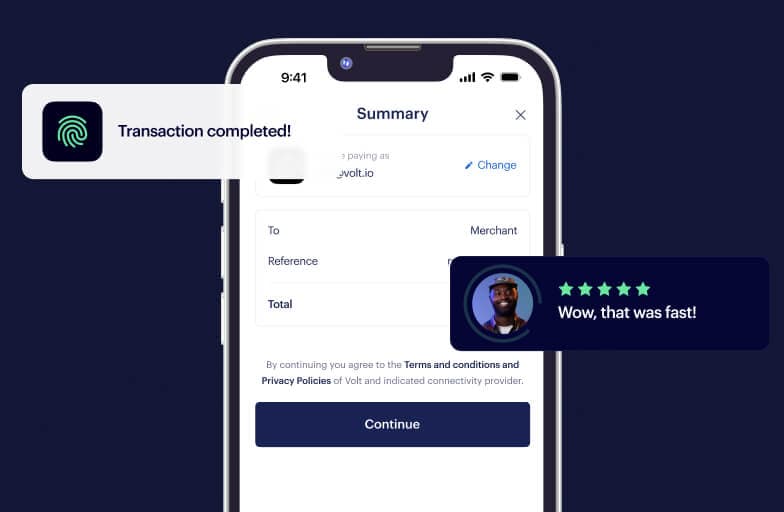
If the frustration in this article sounds familiar, check out this page for more information – plus a preview of what Volt’s checkout looks like. And if you’re a PSP looking for a bank-direct payments solution that isn’t Wero, we’ve got you covered too.
Frequently asked questions
More like this
Market insights
How PayTo compares to other payment methods in Australia
Explore the advantages of PayTo over other payment methods in Australia when it comes to fees, transaction speed, security, and user experience.

Market insights
From screen scraping to PSD3: The growth of open banking in DACH
We look at open banking in DACH, starting with the German Federal Post Office’s experience to the upcoming PSD3 and Payment Services Regulation.

Market insights
Real-time payments in the US: 10 key use cases
We explore how real-time payments can benefit everyday use cases in the US, from online winning payouts to ensuring utility bills are settled instantly.